October 31, 2026 · Timothy O’Brien
Every Shortage Ends in a Glut
Three charts, one old lesson: a shortage is a temporary pricing regime, and the glut that follows sets the real price.
Every shortage is a temporary pricing regime. That is easy to say and hard to believe in the middle of one, so it is worth looking at three markets that have already run the full cycle: the H100, the memory chip, and the SSD. Each started with a shortage, prices moved to levels that made no long-term sense, and then capacity arrived and the prices that followed were the glut’s, not the shortage’s. Three charts, one lesson.
The newest case: the H100
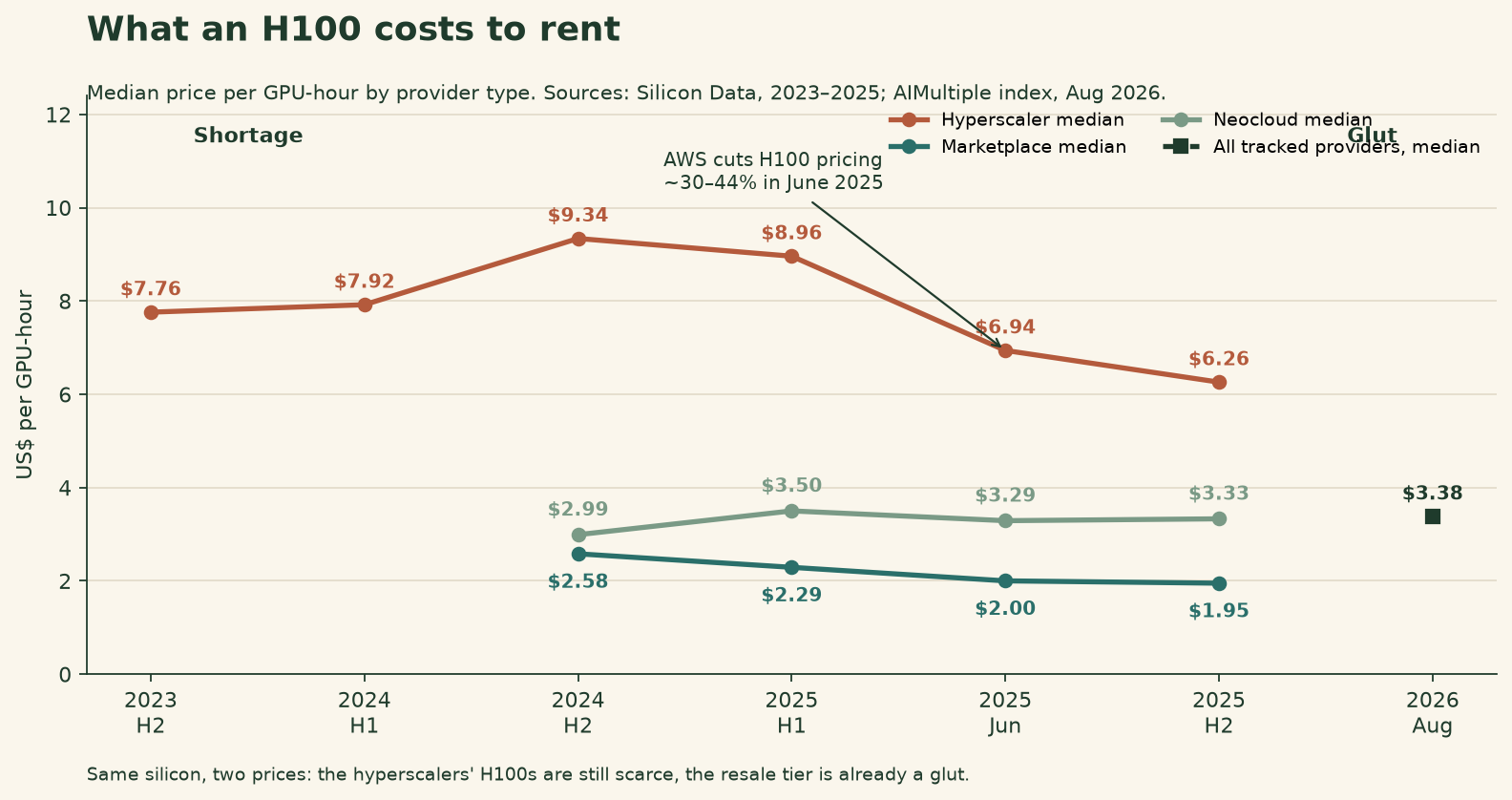
The H100 launched in March 2023 into acute scarcity. Hyperscalers charged a median of roughly $7.76 per GPU-hour in the second half of 2023, and that median was still climbing into the second half of 2024, when it peaked at $9.34. The new cards were expensive too: third-party new listings for an H100 hit $58,900 in June 2023, and used units traded as high as $50,000 during the 2024 shortage.123
Then the glut showed up on schedule. Specialist providers began renting the same silicon for $2.50 to $3.00 an hour in the second half of 2024. When resale proved an H100 could be profitably rented below $3 an hour, the hyperscalers had to respond, and AWS cut H100 pricing roughly 30 to 44 percent in June 2025.4 By August 2026 the median H100 rental across all tracked providers was $3.38 an hour, down about two-thirds from the peak. The chart below makes the split visible: the hyperscalers still charge $6 and up, the resale tier charges $2, and it is the same chip.
The same pattern in memory
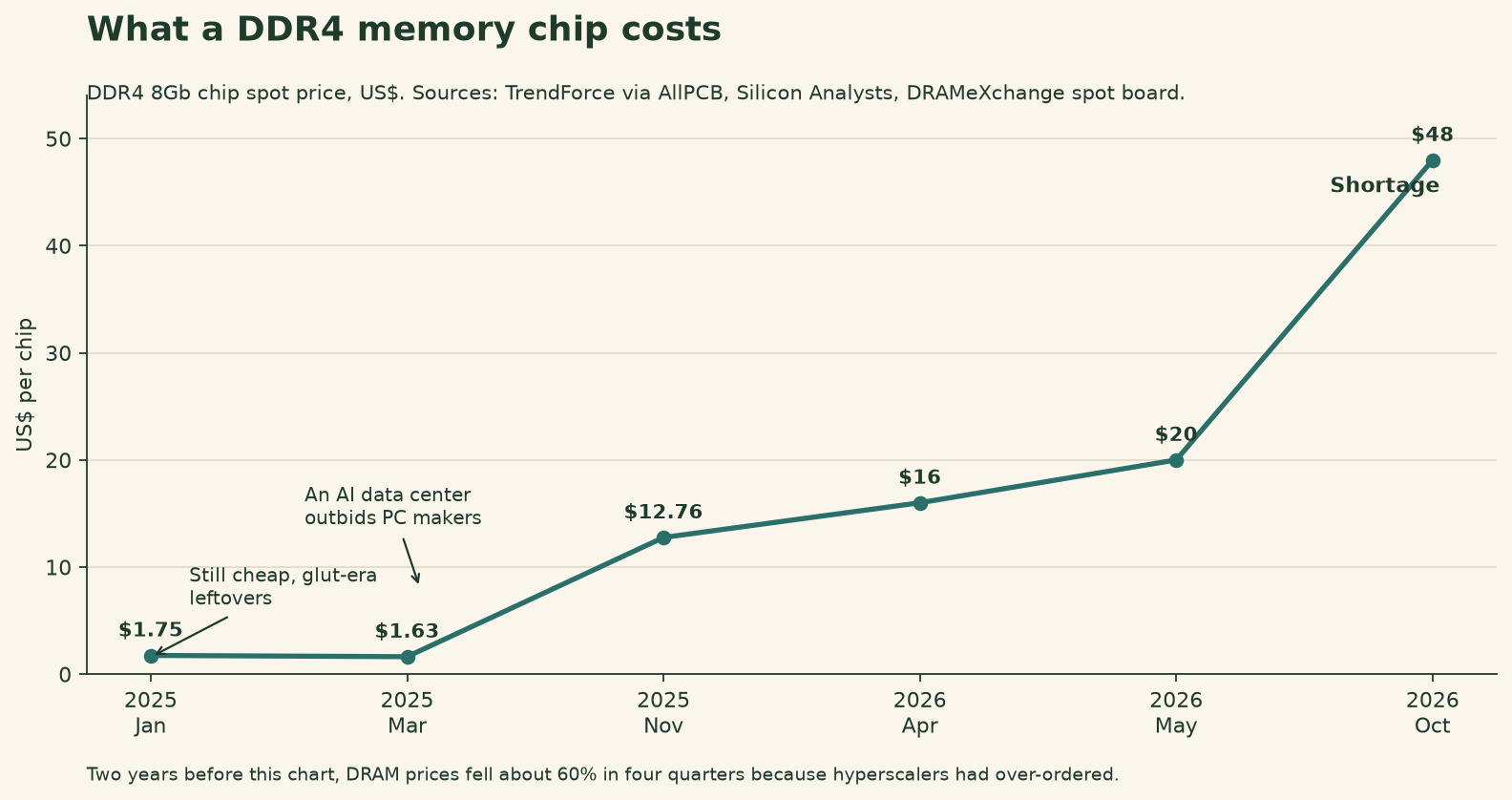
DRAM has run this cycle so often it almost has a schedule. In 2018 the hyperscalers over-ordered for their data-center buildout, pushing industry revenue to $99 billion. In early 2019 they stopped buying. Inventory ran six to nine months long, and DRAM prices fell roughly 60 percent over four quarters.5 In the 2023 trough, Micron’s revenue halved to $15.5 billion in a single year. The memory makers that survived did so by consolidating down to three players who now coordinate supply discipline instead of flooding the market.
That discipline is why the current squeeze is so violent. The same DDR4 chip that cost $1.63 on the spot market in March 2025 sold for $47.11 in October 2026, a 29-fold increase.6 Contract prices rose 90 to 95 percent quarter-over-quarter in Q1 2026, with memory heading toward roughly 30 percent of hyperscaler capital expenditure, up from under 10 percent in 2024.7 The buyers changed, and so did the price regime.
And the same pattern in storage, twice
The SSD supply chain has been disrupted before, and it is worth remembering exactly what that looked like, because the glut that follows is also remembered by almost nobody. In 2011, floods in Thailand took out a quarter of world hard drive production and the supplier of most of the world’s spindle motors. Drive prices rose 80 to 190 percent in weeks, and three months later they were still 60 to 90 percent above pre-flood levels.8
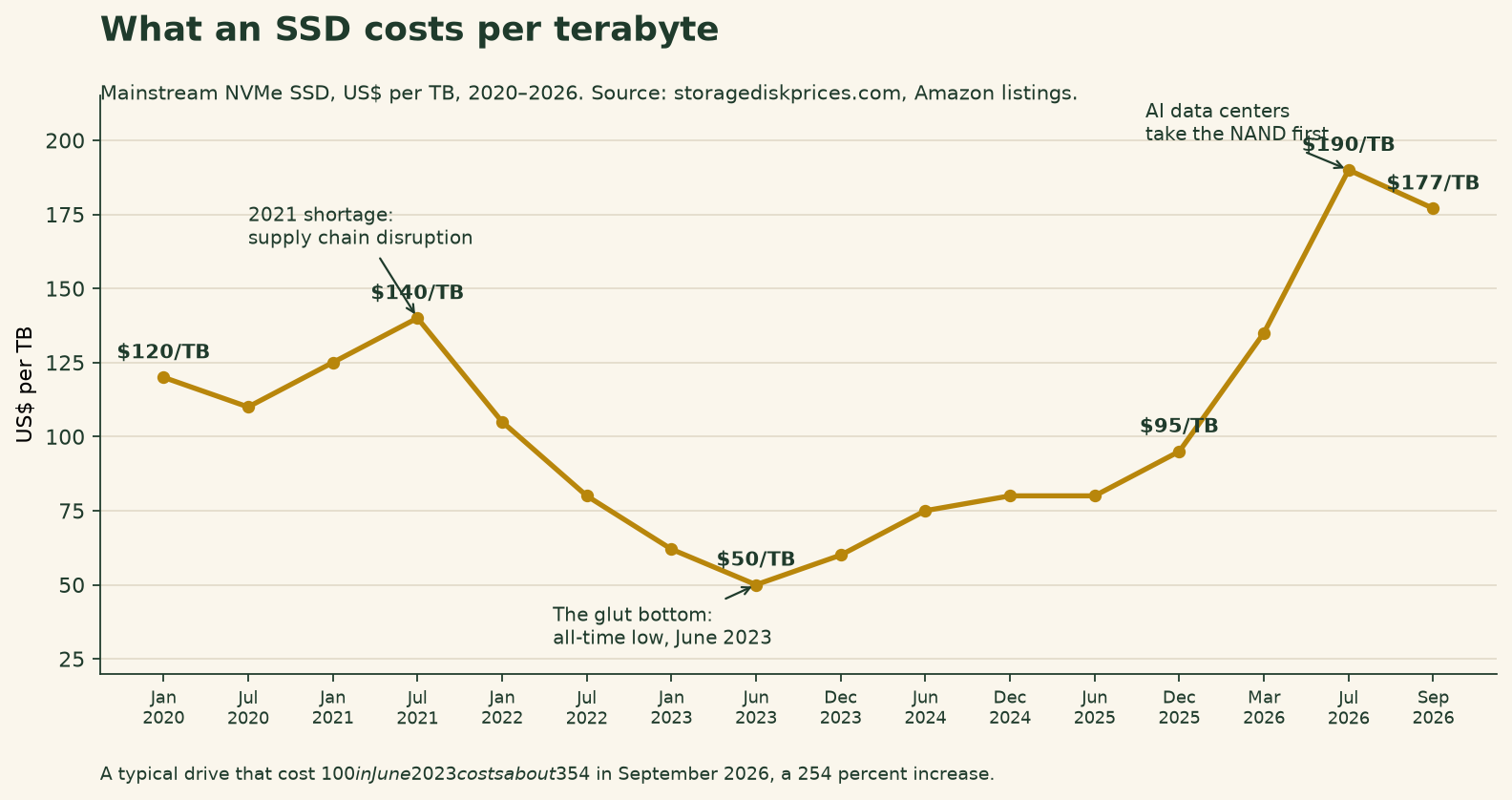
A decade later, in 2021, the SSD shortage arrived, this time from pandemic-era supply chain disruption.9 The mainstream NVMe drive peaked at about $140 per terabyte in July 2021. Then the glut arrived and erased everything: NAND revenue fell 16 percent in a single quarter of 2023,10 and by June 2023 a mainstream drive bottomed at about $50 per terabyte, its all-time low.11
The chart below shows the other half of the cycle: from that bottom, SSD prices have climbed to about $177 per terabyte by September 2026 as AI data centers outbid everyone else for NAND wafers, and NAND contract prices rose 70 to 75 percent quarter-over-quarter in Q2 2026.12
What the pattern says about the AI bubble
Today the market is in the middle of an AI bubble, and the budget numbers are the clearest sign of it. Hyperscalers are expected to spend $755 billion on capital expenditure in 2026, up 83 percent year over year. Gartner has warned that AI data-center capex is unsustainable, with as much as $3.5 trillion at risk of write-down if demand does not keep up.1314
So what happens if demand actually reduces? The historical pattern says the glut comes, and it comes on schedule, not gently. When the H100 buyers finished over-ordering, prices fell 70 percent from peak. When the 2019 hyperscalers stopped buying, DRAM prices fell 60 percent in four quarters. When 2021’s shortage ended, SSD prices fell to their all-time low within a year. The only question is the size of the overshoot. A buying pause like 2019 is a modest glut. A demand reduction like 2023 is a bigger one. Nothing in this history says the price will settle at the shortage’s level; the shortage’s level was never the price. The one lesson from all three charts is that the capacity team’s job is to be the person who notices when the demand curve bends (chapter 19), because every glut in this post started with somebody assuming the current demand was permanent.
Sources
Silicon Data, Dec 21, 2025: H100 Rental Price Over Time (2023–2025) — median rental price per GPU-hour by provider type, 2023 H2 through 2025 H2; June 2025 AWS cut of roughly 30 percent.↩︎
CamelCamelCamel, H100 80GB listing price history: third-party new $58,900 (June 2023) — retail new price peak.↩︎
Hashrate Index, Dec 2025: Used GPU Market: A100 & H100 Pricing, Depreciation — used H100 traded as high as $50,000 during mid-2024 scarcity; AWS June 2025 cut reported at 44 percent.↩︎
AIMultiple Cloud GPU Rental Price Index (via Shattered.io), Aug 25, 2026: H100 Rental Prices Halve to $4.20/Hr in 2026 — median H100 rental across tracked cohort $3.38/hour, down 70 percent from 2023 peak.↩︎
Chip Log, May 2026: DRAM was the worst business in chips, now Micron is worth $1 trillion — 2018 super-cycle, $99B industry revenue; 2019 hyperscaler over-order and ~60% price fall over four quarters; Micron revenue halved to $15.5B in FY2023.↩︎
Silicon Analysts market data, DDR4 8Gb ledger of DRAMeXchange (TrendForce) spot prices, all marked confirmed/high-confidence: DDR4 8Gb spot price — $1.63 (Mar 2025), $12.76 (Nov 2025), $44.37 (Aug 2026), $46.32 (Sep 2026), $47.11 (Oct 23, 2026).↩︎
NAND Research, May 2026: Memory & NAND Flash Crisis — conventional DRAM contract prices +90–95% QoQ in Q1 2026; memory spending ~30% of hyperscaler capex in 2026, up from 8% in 2024.↩︎
TechSpot, Feb 2012: HDD Pricewatch: Three Months Into the Thai Floods — 80–190% price increases at the flood peak, still 60–90% above pre-flood three months later; Thailand supplied ~25% of world hard drive production and Nidec ~70% of spindle motors.↩︎
Fusion Worldwide, 2021: What the SSD Shortage in 2021 Means for the Market — SSD shortage from pandemic-era raw-material and logistics disruption and limited NAND production capacity.↩︎
TrendForce, Jun 1, 2023: Total NAND Flash Revenue Falls 16.1% in 1Q23 — NAND revenue −16.1% QoQ in Q1 2023.↩︎
StorageDiskPrices, Sep 2026: SSD Price Tracker, 2020–2026 — mainstream NVMe $/TB series from its Amazon-listing tracking: about $140/TB (Jul 2021 peak), $50/TB all-time low (Jun 2023), $190/TB (Jul 2026), $177/TB (Sep 2026).↩︎
NAND Research, May 2026: NAND flash contract prices +70–75% QoQ forecast for Q2 2026, from the same May 2026 update.↩︎
NAND Research, May 2026, citing Goldman Sachs consensus: Memory & NAND Flash Crisis — $755 billion hyperscaler capex in 2026, +83% year over year.↩︎
Gartner, via Fierce Network, 2026: AI data center capex is ‘unsustainable’ — $3.5 trillion write-down risk.↩︎